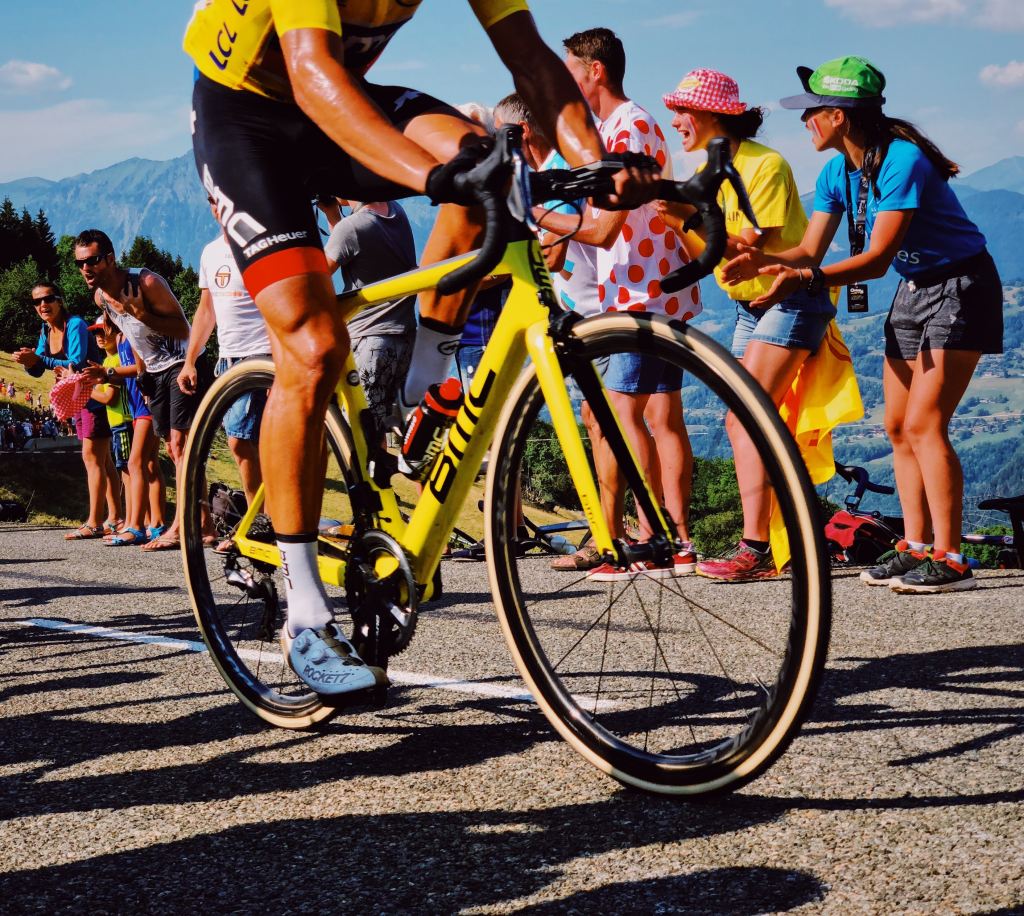
In the last few months, I have gotten very into the slew of sports documentaries available to stream.
I love watching people push themselves to their limits and reach elite athletic status. It’s inspiring to see what bodies are capable of, what people are capable of, and it is so easy to root for people you see working so hard. You want that hard work to pay off for them.
Most recently, I watched Tour de France: Unchained on Netflix and was shocked at how quickly I was hooked.
I have never watched the Tour de France before, and never planned to. I don’t even like riding bikes. It makes me nervous. The last time I was on a bike I slammed my calf into one of the pedals while trying to brake. I walked around for the next three weeks with a blue and then purple and then yellow bruise the size of a grapefruit.
Needless to say, after watching the first episode of the documentary, I did not get that passing feeling of “I wonder if I could do this” the way I do while watching some of the other ones. I knew I couldn’t. But that made it all the more interesting, gripping even, to see that something like this is possible for other people.
But what caught my attention more than anything else, what was most surprising and most interesting to learn about the sport of cycling as a whole, is that it is a team sport.
I didn’t even know there were teams to begin with.
I assumed that, like snowboarding, skiing, etc., there were major sponsors that formed quasi “teams.” Like the Red Bull team, the North Face team, etc. Teams that are comprised of similar branding on their jerseys or stickers on their helmets.
Other than that, I assumed each rider was showing up to ride his own race, for himself, pedaling as fast as he could. I thought cycling was like running—the fastest time wins. Which I suppose in its simplest terms, it is, but there is so much more to it than that.
Without getting into the nitty gritty details that they explain far better in the documentary and, I’m sure, at even greater length online, there are 21 stages of the Tour de France and to win even one is a huge accomplishment. Each stage can play to the strengths and weaknesses of specific riders, so teams can choose who they want to try and win that stage, allowing them to break free from the pack and go for the win.
Amongst the race happening for each individual stage, there is the general classification, which takes into account your time on every stage, giving you a chance to win the entire Tour de France.
The athletes competing for the general classification are known as “leaders” on their teams. And in order for it to be possible for them to be competitive in this regard, their teammates, known as “domestiques”, do everything they can to support them.
They protect them from other racers, set a suitable pace, and allow the leader to draft so they can use less energy. Then at the end of the race, the domestiques move out of the way and let the leader GO.
The first time I watched this happen on the documentary, my eyes opened wide and I thought, NO WAY.
Because as a human, I have an ego, and in that moment, it was so hard to understand how, after months and months of grueling training, putting your body and mind through hell, many of these racers do not get the chance to win.
I was floored by the sacrifice. The humility.
But in watching the documentary, you learn that it’s not always the easiest thing to do.
Sometimes they want a stage to be their stage. They want to take their shot to go for their glory. And at first, I was like, I GET IT. You worked your ass off, if you think you can win it, go for it, babe.
But that’s not the way the sport works.
That’s not the way the team is designed.
Cycling, I’ve learned, is complex in the way that you have to find the drive and ego that allows you to believe you can accomplish near impossible feats of fitness, while also being able to humble yourself and understand your role on the team.
You have to realize that by doing your job successfully, you are, in a sense, winning, even if it is not you crossing the finish line first. You are doing what you came to do, you are putting your training to work, and you are achieving your goal. And even though, at the end, only three people stand on the podium, when your guy is standing at the top, you are part of that celebration because he wouldn’t have gotten there without YOU.
What would it feel like to enter that teamwork state of mind? To know that you are living your purpose, doing the things only you can do, and that you are contributing to the world in a positive way, even if you’re not always standing at the top of the podium?
What can you do for your team today? What can they do for you? What can you do together to make this day, this life, this race a good one?
Stage 4 of the Tour de France sets off tomorrow.
I will be watching with new, inspired eyes. Amazed by the individuals pushing themselves to their limits, and by the teams, moving in practiced synchronicity, working together, trying to achieve the impossible.





 Kimberlee K.
Leave a comment